
Find Yourself: Developing a Passion for your Profession
W.H. is a self-proclaimed "jack of all trades" and has worked more than 80 different jobs before he found the profession he is most passionate about. Read his story to discover how he was not afraid to put himself out there and try different jobs to find a career that fulfills him.
STORIES
Dani Fielder
4/28/20267 min read
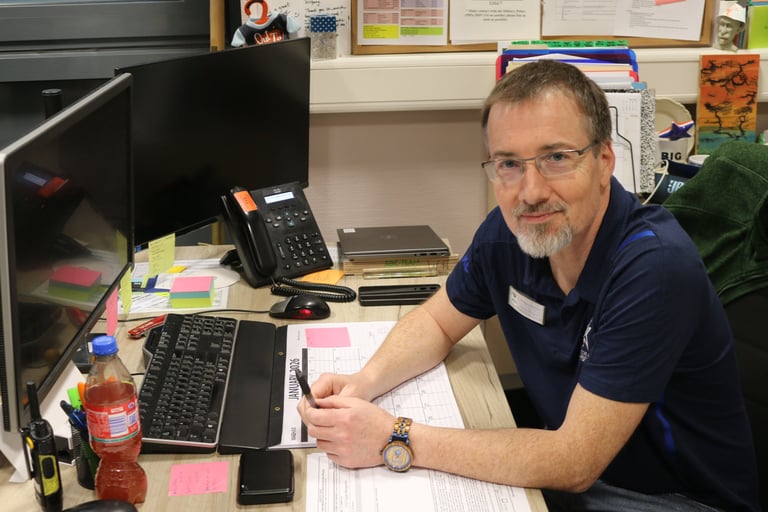
Meet W.H. He is the director of a Child Development Center in Stuttgart, Germany.
W.H. was born in Stuttgart, Germany, but after a month, his family moved to the mid-Illinois country, where he says he was "surrounded by corn fields, soybean fields, and Texaco wells."
In 1986, at the age of 13, he moved back to Stuttgart with his mom, dad, and younger brother for a fresh start. He explained that at this time, "the 80's were different." He continues by going into the limited store hours and the differences in entertainment, saying, "the culture was a lot different, a lot slower paced, even though I did live out in the country in the States."
"It was quite a bit of a culture shock at the start, but I think a lot of the culture shock is the food as well, because you couldn't buy all the different cereals, soda pops, all the different stuff that there is now in the stores now. It was just German-brand, real food." He compared the food in the United States to the food in Germany during this time period, "we lived out of packages, macaroni and cheese, and hot dogs, and [in Germany] you went to the butcher every single day and went to the bakery and got your stuff. You lived off of real, homemade stuff."
Part of the culture shock was the language, as W.H. did not know German at the time. He admits that he did not speak any German when he arrived in Germany, and it was difficult. W.H., however, says he was proficient in German in half a year and mastered the language in a year. "Half a year can be a long time before you can actually have real conversations with people," he reflects. "Especially at that age whenever you should be hanging out in groups and meeting people and, you know, all the stuff you need to be doing as a teen." So, he explains that he tried to learn fast, but that it was difficult.
W.H. remembers feeling left out at certain moments during school because he did not have the same cultural experiences as his classmates. "But on the other hand, it was fun because the 80s was all about the United States and everybody loved it and everybody wanted to be a Hollywood Star." He remarks that, "if you were from America, you were just the greatest thing ever." After being asked if that included himself at this time, he smiles and says yeah, admitting that because of this, his experience in school was alright.
W.H. further explains the school system during the 80's. He clarifies that there were different types of schools: Hauptschule, which lasted about 9 years; Realschule, which lasted about 10 years; and Gymnasium with your Abitur, which lasted about 13 years. He elaborates that he believes the Abitur is similar to a bachelor's. After a year of working for someone for free, you are qualified to go to University and study. Foreigners were typically put in Hauptschule. After he finished his Hauptschule, he went to another school and later completed his Realschule, which qualified him for more jobs. W.H. studied metal, explaining, "It was the easiest to get what he wanted." He expounds by saying, "a lot of companies in Germany are car industry, metal industry, and we have a big emphasis on the metal union here. They're all paid very well." During this time, W.H. felt it was a good idea to first study metal work, then later study economics so that he'd be more qualified to work in the business side of the industry. "That was kind of the plan (...) part of learning how to make everything out of metal, you have to learn how to write all the blueprints for it." After finishing his degree, he moved back to the United States due to a rough patch. He was 23 at the time and moved back to Illinois, but later ended up in Missouri to be near his dad.
W.H. explained that although he started working at 14 as an electrician while he was still in Germany, his experience and education did not transfer over when he moved back to the United States.
'It was very difficult. I had no credit check in the States cause I grew up [in Germany]. I had no references in the States. I had no job history," he justifies. Although it took a while to find a job, W.H. says that eventually he was given a chance to work in a nursing home. "I had filled out at least a hundred applications, and from all those applications, that was the only job I could get." It was 1996, and W.H. reminisces, saying, "Back then, I started working for five bucks an hour. That was a real thing. I was a dishwasher."
Over time, through his hard work, he worked his way up to different positions and better pay. "I've probably done, if I had to guess, between 80 and 90 different jobs, always working my way up," he says. "I've done all the different jacks of all the trades. Honestly, until I came here and started working my job with kids, none of it was fulfilling."
It was 2010 when he finally decided to move back to Germany to provide a better life for his children. At the time, W.H. was a single father at the age of 38, looking for a job to be able to provide for his children. When his friend recommended a job to him, he looked into potential jobs nearby and found a need for a childcare associate. "They took a chance at hiring me, and it worked out," W.H. smiles. "There were always lots of ups and downs, but in the end, the community was very supporting and we always somehow made ends meet."
On the 28th of February, W.H. celebrated 15 years of working in childcare, starting at the lowest level, a Child and Youth Program Associate, or CYPA. "I think if you truly want to be the best version of what you can be at anything, you have to start with the foundations. If you don't have a solid foundation, your house will crumble and fall. Bottom line." He went from caregiver to lead caregiver to assistant director to where he is now as director. Although he is director now, he says he is still striving to gain an even higher position, "to be able to make the most impact."
"I base everything off of the impact that I believe one person can make, and that is truly be the best and the most that you can be at every time, every moment of the day."
When asked if he ever misses being a caregiver, he quickly says, "everyday. There's not a day that goes by that it doesn't cross my mind." He explains that he spent 7 years in the classroom because it is difficult to give up a passion to move on, "but the higher you get, the greater impact you can make because now you're not just affecting one ratio group, you're affecting an entire center."
"I tell a lot of people, 'Listen, if you can do this, you can do anything because of how hard the job is,' cause I've done a lot of jobs and I know this is the hardest one," W.H. emphasizes. In his current position as a director, he finds that his greatest challenge is staffing, "lack of staffing and lack of qualified staffing." He further reveals that it is evident from the way the children behave which caregivers truly have a passion for what they do, versus caregivers who do not.
For anyone beginning a career in childcare, W.H. simply says, "love it or leave it. If you truly spend a month and if you say, 'this is not for me,' then it's not for you." W.H. remembers working in the toddler room on his first day and being bitten on his butt. Although he was ready to leave then, he stayed and ended up mastering that classroom, loving his job, and even later working with other age groups. "It's really fascinating working in childcare. (...) Unless you've tried it, you really can't get an understanding of what it's like. And if you love it, don't be so eager to try and skip the steps. You have to have the experience to become great at something."
W.H. feels as though he has found himself through his work in childcare and urges others to "find themselves" if they do not know the direction they would like to pursue in their life. He explains how he knows people personally who spent a significant amount of money and time in college to pursue things that they do not even enjoy. He described how every "basic," blue-collar job has evolved into other jobs over time, and encourages others to try those jobs out to find their interests. "I've worked as a plumber. (...) I've worked as a roofer. I've worked as a framer. I've worked as a car mechanic," W.H. states. "No matter how old you are (...) you have to know who you are. So, don't waste your money going to college to study something because you might be a great whatever. Spend the time to find out who you are cause once you know who you are, then you know what you want to be."
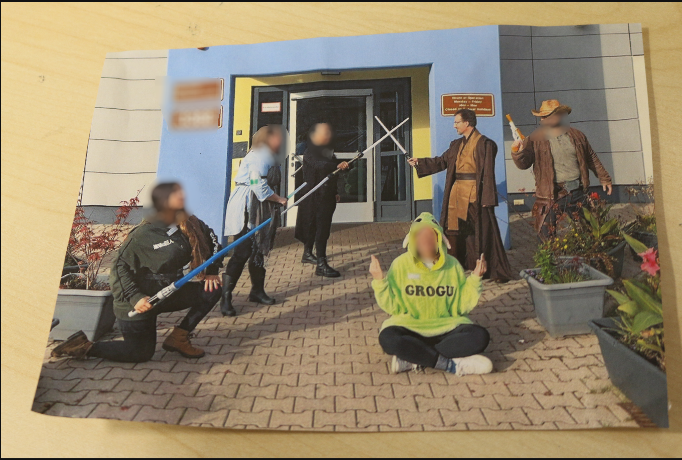
W.H. shows off a picture of himself and some of his employees taken on a Star Wars-themed work day (Photographed by Dani Fielder).
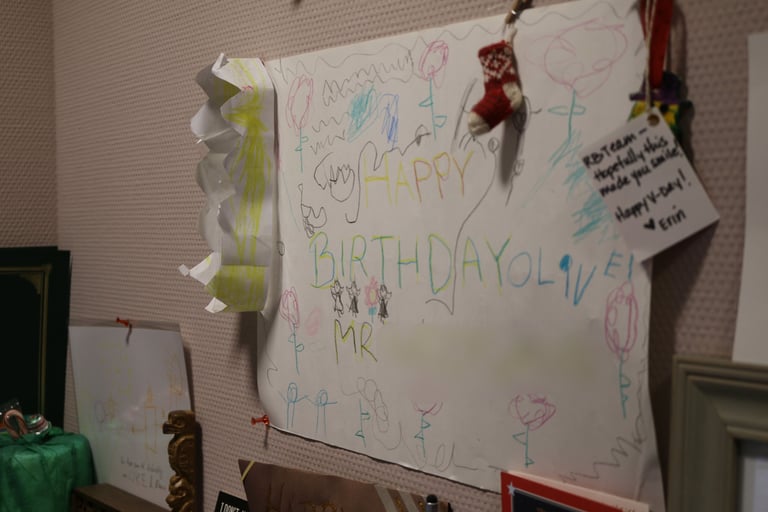
A hand-drawn birthday card hangs behind W.H.'s desk, decorating his area (Photographed by Dani Fielder).
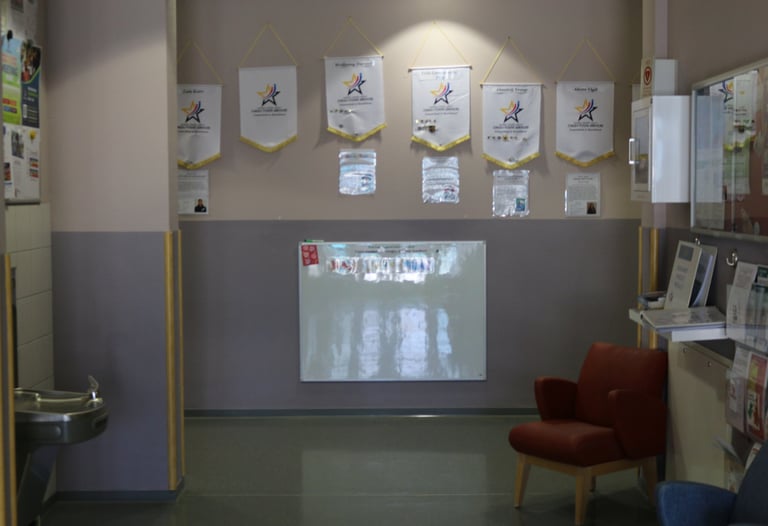
The entrance way of the childcare facility has parent resources (shown on the right), parent information (shown on the left), and banners that showcase each of the employees in the facility (Photographed by Dani FIelder).
W.H. sits smiling in his office at a desk scattered with paperwork (Photographed by Dani Fielder).